Performance Status Nutrition
The Overzealous Fighters
When immune cells over-react - a case of autoimmunity
GENERAL IMMUNE SYSTEM CATEGORY
12/30/20254 min read
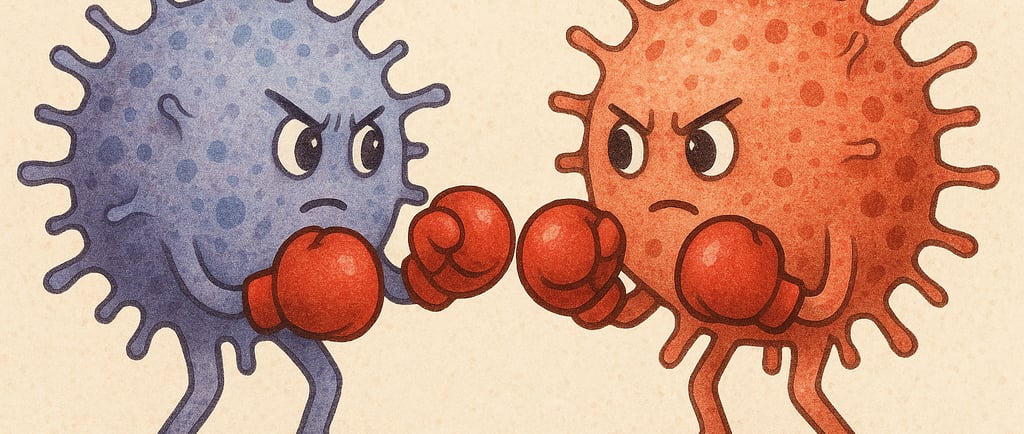
The Overzealous Fighters - When immune cells over-react - a case of autoimmunity
It has been established that we do not live in a perfect world and although our immune system works extremely hard to keep us healthy, bad things happen. Some of these unpleasant things may be short-lived like a 24-hour virus, others may be chronic in nature such as a slow and persistent low-grade inflammation that occurs when we undergo chronic stress or illness. The key ingredient again, is inflammation. Inflammation causes changes to our cells and triggers our immune system to react. Chronic stimulation of the immune system can cause the cells to exhaust or to overreact. This overreaction can cause the immune cells to get confused and not be able to recognize the healthy cells from the infected cells and attack the healthy host. This is why we call it an autoimmune reaction.
Similar to cancer, autoimmune diseases are often a result of genetic predisposition along with environmental exposure that causes stress and inflammation to cells. The autoimmune reaction is different from the cancer response in that the immune system assumes there is a threat to the host, so B cells begin to create antibodies (autoantibody) that attack the body’s own protein antigens (autoantigens). There are also self-activating T cells that secrete cytokines that also attack host cells. The cells targeted in this autoreactive battle are often unique to each disease. Examples include pancreatic cells for Diabetes, thyroid cells for Hashimoto disease, the nerve cells for multiple sclerosis.
Autoimmune diseases often take time to develop and one reason for this is that the immune system ages and loses its ability to tolerate its own cells. Normally a CD8+ T cell will see an antigen and quickly attack it and then die. These cells, when regulated and in good function will easily determine what is a threat (even be able to differentiate healthy bacteria or germs from harmful ones). During an autoimmune reaction, the ability to tolerate healthy and safe cells, tissues or microbes is lost and the auto reaction dominates. Let’s examine a couple common viruses we may all be familiar with. COVID-19 and Epstein Barr Virus (or commonly known as mono).
COVID-19
There is still some controversy on the risk of autoimmune disease developing post COVID-19 yet studies have shown increases in systemic lupus erythematosus (SLE), Sjögren's syndrome, and autoimmune connective tissue diseases following exposure to the COVID-19 coronavirus. Many studies have verified that there is a significant number of cytokines released during COVID-19 infection and many of us are familiar with the term “cytokine storm” during the pandemic. The pro-inflammatory cytokines released during the infection induced immune reactions that are very similar to the autoimmune reaction that occurs during autoimmune flares. So similar, that during COVID-19, autoimmune medications were often prescribed to calm the cytokine storm. Autoantibodies have also been found with COVID-19 along with systemic organ damage that is seen with other autoimmune diseases. The speculated mechanisms for an autoimmune reaction during COVID infection includes reduction in self-tolerance as mentioned earlier, overactivation of immune cells, production of autoantibodies, and a mechanism referred to as molecular mimicry which will be explained further in the next example virus, Epstein-Barr Virus.
Epstein-Barr Virus
The majority of us will have had EBV or Epstein-Barr Virus in our lifetime and we never knew it. Therefore, not every person who gets this virus commonly referred to as “the kissing disease” or “mono” will ever develop an autoimmune disease. That is GOOD! EBV is a herpes simplex virus 4 that is passed from person to person through saliva and may cause fever, fatigue and enlarged spleen or lymph nodes. The fatigue can last months and can cause serious complications in some individuals. After EBV has occurred, the antibody Epstein-Barr virus nuclear antigen-1 (EBVNA-1) will circulate in the body for the rest of the person’s lifetime and lay dormant and not cause any problem for most of us. But for some unfortunate people, evidence has shown that EBV has been linked to autoimmune diseases later in life including multiple sclerosis (MS) and SLE.
EBV is extremely clever. This virus has the ability to easily evade the hard-working immune system through several special powers as shown below:
Camouflage artist: ability to hide and wrap itself in the healthy selves' membranes which is called envelopment.
Active stage shifter: EBV has the ability to shift between a latent stage where it easily evades the immune response yet can shift to a lytic stage by producing virus proteins.
The amazing mimic: molecular mimicry is where the viral infection can contain a protein that looks like a normal healthy protein and evade an immune response. EBVNA-1 has a similar structure and look to a protein found in Multiple Sclerosis called β synuclein (a brain protein that has been found with MS). It is when the immune system loses tolerance and no longer recognizes that the EBVNA-1 is not harmful that an autoimmune reaction will occur. EBV has several of these sneaky proteins.
The great immobilizer: EBV can secrete substances that interfere with activation of the adaptive immune response. These substances can create and decoys the immobilized stem cells.
The immortal killer: EBV is so smart it also has a method to prevent apoptosis (programmed cell death) allowing the virus to continue its damage. It does this during the lytic phase when producing viral proteins that allow replication of viral DNA and avoids Natural Killer Cell identification.
Summary Key Points:
Inflammation triggers an immune response
Genetic factors or environmental events make some people susceptible to an overactive immune response.
Autoimmune response occurs when autoantibodies and autoantigens are produced causing the immune system to attack healthy self cells that lead to disease.
Although research is mixed, some viruses have been linked to autoimmune diseases later in life.
References
Pisetsky DS. Pathogenesis of autoimmune disease. Nat Rev Nephrol. 2023 Aug;19(8):509-524. doi: 10.1038/s41581-023-00720-1.
Baessler A, Vignali DAA. T Cell Exhaustion. Annu Rev Immunol. 2024 Jun;42(1):179-206. doi: 10.1146/annurev-immunol-090222-110914.
Zheng Y, Liu Q, Goronzy JJ, Weyand CM. Immune aging - A mechanism in autoimmune disease. Semin Immunol. 2023 Sep;69:101814. doi: 10.1016/j.smim.2023.101814.
Läderach F, Münz C. Altered Immune Response to the Epstein-Barr Virus as a Prerequisite for Multiple Sclerosis. Cells. 2022 Sep 4;11(17):2757. doi: 10.3390/cells11172757.
Heo Y, Jeon JJ, Ha MC, Kim YH, Lee S. Long-Term Risk of Autoimmune and Autoinflammatory Connective Tissue Disorders Following COVID-19. JAMA Dermatol.
2024;160(12):1278–1287. doi:10.1001/jamadermatol.2024.4233
Houen G, Trier NH. Epstein-Barr Virus and Systemic Autoimmune Diseases. Front. Immunol. 2021. 11:587380.doi: 10.3389/fimmu.2020.587380