Performance Status Nutrition
Monitoring Stress
Stress is inevitable but the goal is always to balance out that stress with adequate rest and recovery. Our bodies have subtle ways of telling us when that balance is off - learn about a few biometric measures that may help us monitor stress.
MONITORING METHODSBASELINE MEASURE
3/30/20265 min read
Stress Monitoring
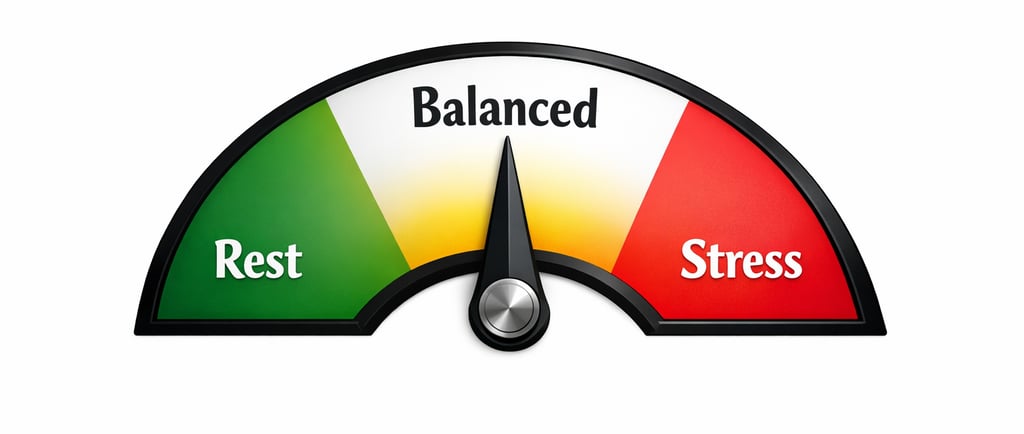
Stress is a part of life. Stress is healthy for us if not chronic and compounded with other stressors. Recovery must follow the stress in order to repair the damage and get us back to stable baseline. Whether we are trying to balance athletic training stress to our rest and recovery periods or if we already have a chronic illness and we are trying to balance inflammation with rest to prevent a full-blown flare-up, we are often trying to assess the balance scale. There are many metaphors to illustrate this balance of rested vs stressed - “How full is our tank?” “What is my bank account balance? Am I overdrawn?”. From a neurological perspective, we refer to our autonomic nervous system as a way to regulate this balance. Let’s dig into what that means and then ways we can measure it.
Autonomic Nervous System (ANS): A very complex process that helps “automatically” manage nearly every organ system in our bodies that is controlled by central neuron cells that try to maintain balance within our body. It does all this like a well programmed computer controlling activities without our awareness.
Examples of this control include:
Control of circulation (blood pressure, heart rate etc.).
Control of respiration (breath rate)
Control of body temperature
Control of pain reaction
Control of emotions
Control of bowel and bladder
Control of circadian rhythm
Control inflammation in chronic and acute conditions
Divisions of the ANS
Sympathetic Nervous System (SNS): Also referred to as the “FIGHT or FLIGHT” or as I like to remember S for “stress” state. During SNS, we have increased heart rate, respiratory rate, blood is moved to extremities and less to intestines as we prepare to flee from our stress. The SNS also innervates the immune system organs (thymus, spleen and lymph nodes).
Parasympathetic Nervous System (PNS): This phase is our “REST and DIGEST” or as I like to say P for “peaceful” state. During PNS, our heart and breathing rate slow down, our digestion can resume and we feel more relaxed. A dominant PNS component is the vagus nerve that helps mediate the digestion process as well as stimulate anti-inflammatory effects.
Enteric Nervous System (ENS): This system regulates absorption by helping with movement of water and electrolytes across the intestinal mucosa. Bowel motility is also regulated by the ENS as well as our feelings of fullness.
Our bodies are constantly responding to physical and psychological events and desire to quickly return to a normal baseline. Due to the complex interactions between our many body systems (such as cardiac, respiratory, endocrine), the best guidance is looking at many measures and not relying on just one to make decisions about our health or fitness plans. Despite that complexity, measuring how our body responds and rebounds to stress are helpful on our journey for balance. In previous blog articles, we have shared self-assessment questionnaires that help assess physical, emotional and social stressors by answering questions. Today, we would like to look into biometrics that may help us identify what our body is telling us about our stress and recovery efforts. There are many metrics available, but we will discuss biometrics that most of us have access to.
Cardiac Measures
Athletes are familiar with the importance of heart rate monitoring. Below are easy ways to obtain cardiac measures and how they may be related to recovery.
Resting Heart Rate (RHR): your heart rate at complete rest.
Lower RHR or close to baseline may indicate recovery
Higher RHR (5-7 beats above average) may indicate a need for more rest
Heart Rate Recovery (HRR): The difference in heart rate during exercise and 1 minute after stopping the exercise.
Fast and rapid drop in heart rate following exercise is a sign of good recovery (aim for a decrease of 18 beats the minute after exercising).
Less than a 12-beat drop may indicate more rest is needed
Heart Rate Variability (HRV): the time measured in milliseconds between each heartbeat.
The interval between each heart beat is called an R-R interval. It is called normal-to-normal intervals or NN which is a more precise ANS measure. HRV is commonly reported as :
SDNN (standard deviation of NN), Lowers with stress
RMSSD (root mean square of the differences in successive R-R intervals). Increases with rest.
HRV does not have reliable reference standards and is best when used to compare reading to an individual's baseline value.
Low HRV relative to baseline average may indicate a SNS dominated state from increased workloads, stress and inflammation. This could be a sign of overtraining.
High or normal HRV relative to baseline average may indicate a PNS dominated state due to adequate rest and recovery post training or other stressors.
For best results, measure at the same time, same position using the same instrument to monitor HRV.
Many biometric watches, rings or other monitors may each use a different HRV metric so do not compare results from one device to another.
HRV is very complex and can be affected by many things including illness, body temperature, physical fitness level, medications and alcohol so best to evaluate trends and not make decisions based on just HRV.
Respiratory Measure
Respiratory Rate (RR): The number of breaths we take in 1 minute is our RR.
Average adult RR is 12-20 breaths per minute
RR is an indication of metabolic demand so when under high demand, the RR will increase.
RR will increase as oxygen demands increase.
As oxygen demands decrease and waste products are eliminated, RR returns to normal.
Summary Key Points
Our heart, lungs, and so many other bodily systems help our bodies manage stress.
Allowing our body systems to respond to stress takes time.
When that time is completed, certain biometrics may give us information that tells us we can tolerate more stress.
Getting to know our baseline biometrics will go a long way to helping us monitor stress.
Measuring these biometrics may be another tool in our toolbox to assess our performance status.
Signs the body is well rested and balanced
RHR is lower or at our baseline
HRR drops >18 beats per minute 1 minute after exercise
HRV is at or higher than baseline
RR is at baseline for calm breathing - usually 12-20 breaths per minute
References:
Gibbons CH. Basics of autonomic nervous system function. Handb Clin Neurol. 2019;160:407-418. https://doi.org/10.1016/b978-0-444-64032-1.00027-8
Bellocchi C, Carandina A, Montinaro B, Targetti E, Furlan L, Rodrigues GD, Tobaldini E, Montano N. The Interplay between Autonomic Nervous System and Inflammation across Systemic Autoimmune Diseases. Int J Mol Sci. 2022 Feb 23;23(5):2449. https://doi.org/10.3390/ijms23052449
Waxenbaum JA, Reddy V, Das JM. Anatomy, Autonomic Nervous System. [Updated 2025 Dec 1]. In: StatPearls [Internet]. Treasure Island (FL): StatPearls Publishing; 2026 Jan-. Available from: https://www.ncbi.nlm.nih.gov/books/NBK539845/
Shaffer F, Ginsberg JP. An Overview of Heart Rate Variability Metrics and Norms. Front Public Health. 2017 Sep 28;5:258. https://doi.org/10.3389/fpubh.2017.00258
Addleman JS, Lackey NS, DeBlauw JA, Hajduczok AG. Heart Rate Variability Applications in Strength and Conditioning: A Narrative Review. J Funct Morphol Kinesiol. 2024 May 27;9(2):93. https://doi.org/10.3390/jfmk9020093
Burton, DA, Stokes, K, Hall, GM. Physiological effects of exercise. Continuing Education in Anaesthesia Critical Care & Pain. 2004. https://doi.org/10.1093/bjaceaccp/mkh050