Performance Status Nutrition
Measuring Function and Performance
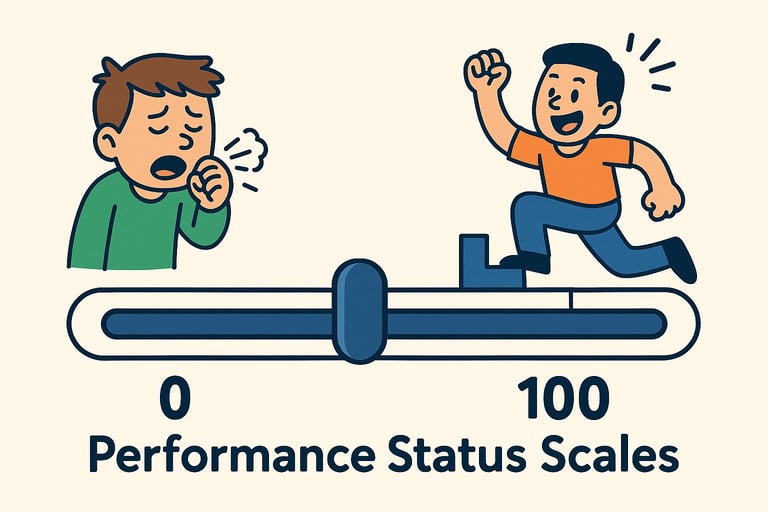
Performance status scales have been used for decades to measure how well a person is functioning before and during treatments. There are a number of validated tools to measure and assess function or performance with examples shared in today's post.
MONITORING METHODSBASELINE MEASURE
3/6/20264 min read
Performance Status
Cancer providers have been using some variety of a scale to measure their cancer patient's performance status (PS) since the late 1940’s. The PS scale is a method to quantify and measure how well a cancer patient is doing with their daily activities. Initially the scales were used to determine how effective the cancer treatment was, and a measure of how the treatment was affecting them at a given time. Over the past nearly 80 years, PS scales are used to predict outcomes, improve treatments and used as criteria for participation in clinical trials.
KPS and ECOG
The Karnofsky Performance Status (KPS) was the first tool created and included a max score of 100 defined as well-functioning to the lowest score of 0, indicating death. The scale changed by 10-point increments such as 90/80/70/60 etc. Example for a 90 KPS may be the patient who is doing most normal activities but does have a few symptoms. A KPS of 70 may be the patient who is taking care of own self but not able to do normal daily work or activity. When the score dips to 60 the patient is often requiring some help from others for their daily activities.
The second tool created was the Eastern Cooperative Oncology Group (ECOG) performance scale that uses a 6-point scale. The lower the score the better for this one - a 0 score for ECOG means the patient was performing full activities independently and a 5 would mean death. An ECOG-1 score may indicate some limitations in the strenuous activities but able to do the day to day. ECOG - 2 show more limitations with half of the day sitting in a chair or bed. ECOG-3 progresses to limited self-care.
Goal Scores for optimal outcomes usually are KPS > 60 and ECOG < 2.
Performance Status vs. Functional Status
Scales are important to use and measure for research. It reduces some of the subjectivity to assessments. It is easier to compare outcomes by scores of 70-100 or 1-5 vs 100 patients with varied remarks like “I am tired”; “I am doing OK” or “I feel worse than last week”. It forces us to reflect on our abilities and quantify them. What the scales can’t do is tell you what is causing the lower or higher score. So many things can impact performance other than the actual disease. For example, if nutrition is poor and we lose muscle mass we will ultimately lose the ability to perform at our normal activity level thus reducing our PS. Improve nutrition and PS improves yet the disease level is the same or even worse. Nutrition professionals have assessed functional status as part of their nutrition-focused exams for many years, and this is similar to a PS. Geriatric medicine has also evaluated function using a variety of scales to determine how well a person is able to carry out basic activities of daily living. All of these scales are helpful for assessing our performance. Today’s post will highlight just a few assessment tools of basic function or performance beyond the KPS or ECOG oncology scales.
Examples of Activity of Daily Living Scales
Barthel Index: this 100-point scale looks at 10 items. points (0-15) if independent with:
feeding, bathing, grooming, dressing, bowel control, bladder control, toilet use,
transfers, mobility and stair climbing. Higher scores indicate higher function.
Katz Index of ADLs: this tool scores one point for those who can independently do:
bathing, dressing, toileting, feeding, transferring and maintaining bowel and
bladder continence. 6 points is a good score with a 0 being very poor.
Cancer treatment scales
FACT-G (functional assessment of cancer treatment - general) - 27 questions about physical, social, emotional and functional well-being.
EORTC QLQ-C30 - this is a 30-question tool that has the patient reflect on the past week and answer on a 1-4 scale (1 = not at all and 4= very much) covering many aspects of cancer treatment side effects such as: nausea, vomiting, pain, appetite, finances, emotional and social functions. Scores are monitored weekly and a 10-point change in a week is significant.
These are just a few examples of tools that have been validated in research studies and may be helpful for monitoring functional status while undergoing medical treatments. Regardless of any scale selected, it is helpful to have some method of reflecting on how you are performing with a scale you can repeat again and again to determine setbacks or successes. Sometimes there are interventions we can employ that will improve our PS and these scales can help us determine if they are working or if we should modify them. Sometimes, there are no interventions that will help us, but we can then communicate with more detail to our medical providers what our status is and if using a comprehensive tool, we can pinpoint what area needs work to improve. It is recommended to all patients undergoing medical treatments to discuss a mutually agreed upon scale with their providers to optimize treatment and overall communication. This is a proactive, patient-centered approach to care.
Summary Key Points:
Performance Status (PS) or Functional Status Scales are tools to quantify and score where we are functioning with simple day to day activities.
Scored scales allow us to reflect on our performance in a consistent method that allows variations in scores to be discussed with health professionals or as self-assessment check-ins.
Validated scales help researchers determine success of medical treatment while also communicating specific areas of concerns while undergoing various treatments.
For optimal care, both providers and patients should discuss and agree on a tool that increases communication throughout care. The best tool is the one that fits the medical diagnosis, and simple enough to be used in the typical medical clinic. `
References
Scott JM, Stene G, Edvardsen E, Jones LW. Performance Status in Cancer: Not Broken, But Time for an Upgrade? J Clin Oncol. 2020 Sep 1;38(25):2824-2829. https://doi.org/10.1038/bjc.1993.140
Hartigan I. A comparative review of the Katz ADL and the Barthel Index in assessing the activities of daily living of older people. Int J Older People Nurs. 2007 Sep;2(3):204-12. doi: 10.1111/j.1748-3743.2007.00074.x. PMID: 20925877. https://doi.org/10.1111/j.1748-3743.2007.00074.x
Cocks K, Wells JR, Johnson C, Schmidt H, Koller M, Oerlemans S, Velikova G, Pinto M, Tomaszewski KA, Aaronson NK, Exall E, Finbow C, Fitzsimmons D, Grant L, Groenvold M, Tolley C, Wheelwright S, Bottomley A; European Organisation for Research and Treatment of Cancer (EORTC) Quality of Life Group. Content validity of the EORTC quality of life questionnaire QLQ-C30 for use in cancer. Eur J Cancer. 2023 Jan;178:128-138. https://doi.org/10.1016/j.ejca.2022.10.026
Cella DF, Tulsky DS, Gray G, Sarafian B, Linn E, Bonomi A, Silberman M, Yellen SB, Winicour P, Brannon J, et al. The Functional Assessment of Cancer Therapy scale: development and validation of the general measure. J Clin Oncol. 1993 Mar;11(3):570-9. https://doi.org/10.1200/jco.1993.11.3.570